Plancha Meaning: What Is a Plancha, How It Works & Why Every Kitchen Needs One
You’ve seen it on restaurant menus. You’ve heard chefs talk about it. But what exactly does plancha meaning cover — and why does this one word show up in Spanish kitchens, French menus, American barbecues, and even hair salons?
The answer is richer than most people expect. Plancha is a word with a whole world behind it.
What Is the Plancha Meaning? Definition, Origin & the Word Behind the Sizzle
Plancha is a Spanish word. At its most direct, it translates to “iron plate” or “flat iron.”
In English, the closest equivalents are: griddle, iron plate, flatiron, smoothing iron, or flat slab. But none of these fully capture what plancha means in a culinary context.
So what does plancha mean in cooking?
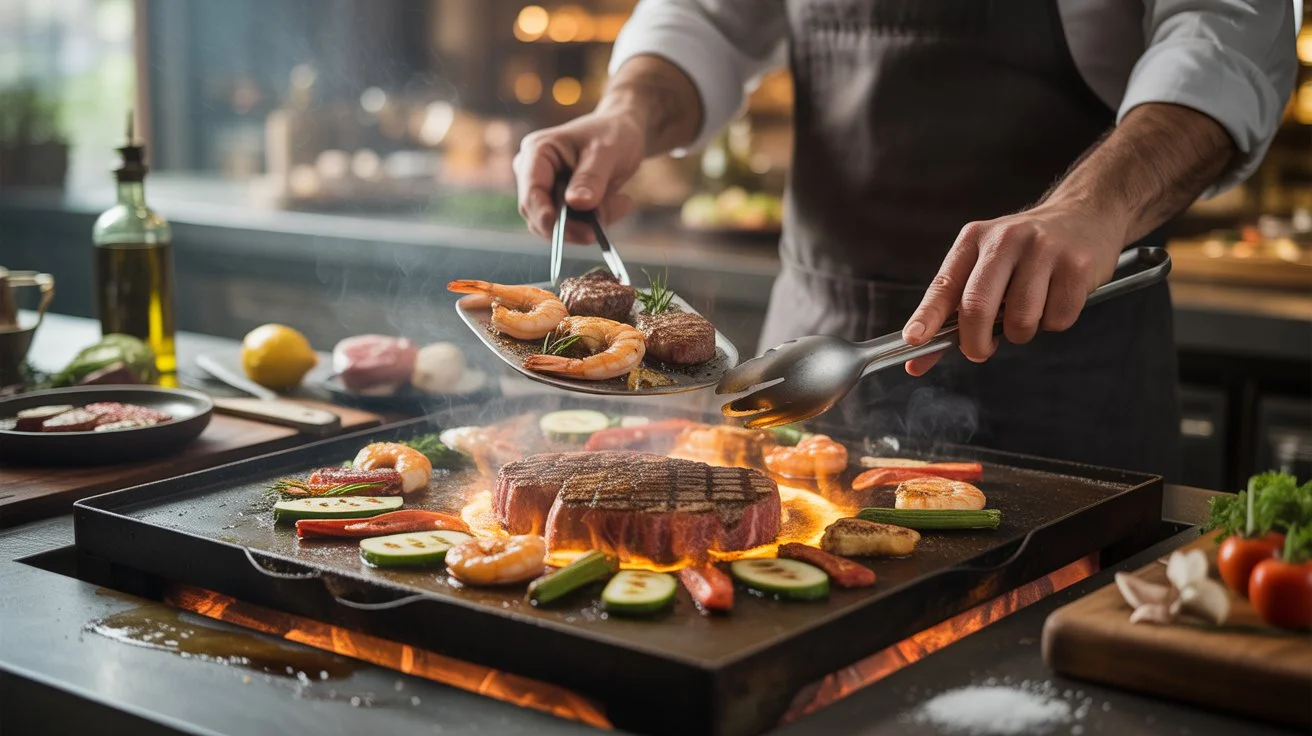
In the kitchen, plancha meaning refers to a thick, smooth, intensely hot metal surface used to sear food at extremely high temperatures — with almost no oil required.
It is both a tool and a technique.
When you see à la plancha on a French menu, it means the dish was cooked directly on this flat iron surface. When a Spanish recipe says cocina a la plancha, it means the same thing: high-heat, flat-surface cooking that locks in flavor and moisture.
What does plancha mean in French specifically?
In Southern French and French Basque cuisine, the word appears as both plancha and planxa — the Catalan and Basque spelling. Both refer to the same iron cooking plate. The French adopted this technique from their neighbors across the Pyrenees, and it became deeply embedded in coastal and Basque-influenced French cooking.
What is plancha in America?
In the United States, plancha typically refers to the flat cooking surface used in Spanish-inspired or upscale restaurant kitchens. It is functionally similar to a commercial flat-top griddle, but the heat behavior, material thickness, and cooking philosophy are distinct. Among US Latino communities, plancha also commonly means a hair flat iron — a completely different tool, but rooted in the same core meaning: a flat, smooth, pressing surface.
The History of the Plancha — From Aztec Clay Plates to Michelin-Starred Kitchens
The plancha’s story does not begin in Spain. It begins far earlier — in pre-Columbian Central America.
The Aztec and Maya civilizations cooked corn bread on flat clay plates called comales, heated from below over an open fire. When Spanish Conquistadors arrived in the Americas, they encountered this flat-surface cooking method and eventually introduced iron plates on top of those clay surfaces.
That fusion — indigenous flat-surface heat + Spanish iron — is the most credible origin of what we now call the plancha.
Why do Spain, France, and the Basque Country all claim it?
Because all three cultures absorbed and evolved the technique independently over centuries. The Spanish called it plancha. The Catalan-speaking regions of northeastern Spain called it planxa. The French Basque communities — who straddle the border of both countries — used planxa as their own. Southern France followed naturally.
Over time, the tool itself evolved. Early planchas were thin iron sheets — so thin they would warp from the heat, bowing upward in the center. That wasn’t a flaw. That central hump naturally drained excess grease away from the food, keeping it moist rather than dry like a barbecue would.
Modern commercial planchas are cast iron or stainless steel, approximately 1.5 cm thick, often coated with a layer of non-reactive chrome to prevent flavor transfer between dishes and simplify cleanup.
Today, plancha cooking is featured in Michelin-starred restaurants worldwide. The MICHELIN Guide has described it as a technique that demands ingredient quality above everything else — because there is nowhere to hide on a flat, searing-hot surface.
Must Visit: MBN Meaning 2026: What Does MBN Mean in Text, Chat & Social Media?
How a Plancha Works — The Science of Searing, Heat Zones & Why It Beats a Griddle
This is where the plancha separates itself from every other flat cooking surface.
How hot does a plancha get?
A plancha reaches approximately 350°C (662°F) — significantly hotter than most home griddles or cast iron pans. That extreme heat is what creates the Maillard reaction: the chemical browning process that forms the golden, flavorful crust on the outside of proteins while sealing natural juices inside.
What makes the plancha different from a griddle?
On a standard griddle, heat is distributed relatively evenly. On a plancha, heat concentrates at the center and gradually decreases toward the edges. This creates natural temperature zones across a single surface.
That means a chef can sear a steak in the center at full intensity while simultaneously keeping delicate vegetables warm at the cooler edges — all without touching a dial.
Plancha vs griddle vs grill: what’s the real difference?
| Method | Heat Type | Oil Needed | Flavor Outcome |
|---|---|---|---|
| Plancha | Concentrated center heat | Minimal | Intense sear, retains juices |
| Griddle | Even distributed heat | Moderate | Light browning, less crust |
| Grill | Direct flame/charcoal | Low | Smoky, charred marks |
| Sauté pan | Conduction | Medium-high | Soft browning, single item |
The plancha wins on flavor retention and speed. It sears without burning, caramelizes without drying, and cooks multiple proteins simultaneously at different temperatures.
Why does the plancha use so little oil?
Because the searing surface does the work. A light brush of high smoke-point oil — grapeseed, avocado, or olive oil — is all that’s needed to prevent sticking. The food cooks in its own juices, not in fat.
This is why cocina a la plancha is considered one of the healthiest professional cooking techniques in modern gastronomy.
What Is a Plancha Used For? Foods, Dishes & Classic Recipes à la Plancha
The plancha is one of the most versatile cooking surfaces in any kitchen. Here is how it is used across cultures and cuisine types.
What is plancha food in Spanish tradition?
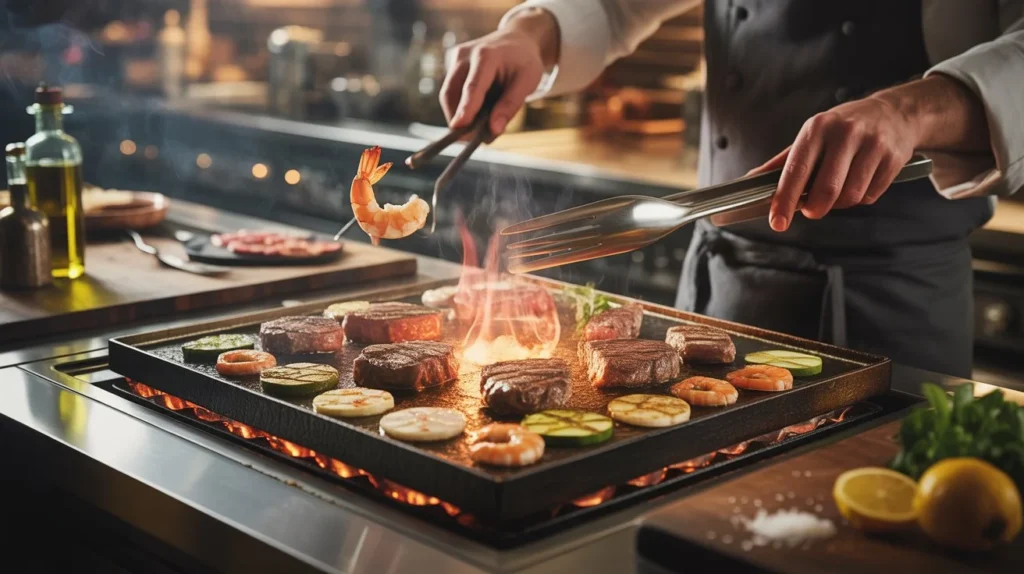
The most iconic example is Gambas a la plancha — seared prawns cooked on a hot iron plate with olive oil and sea salt. This dish is as fundamental to Spanish tapas culture as patatas bravas or tigres. It is simple, fast, and deeply flavorful.
Classic French Basque plancha dishes include:
- Crevettes Ail et Persil à la Plancha — shrimp with garlic and fresh parsley, a staple of Basque coastal cooking
- Magret de Canard à la Planxa — seared duck breast, one of the most celebrated planxa preparations in southwestern France
- Côtes d’Agneau des Pyrénées à la Plancha — Pyrenean lamb chops, seasoned simply and seared fast
- Chorizo à la Planxa au Cidre Basque — chorizo pork sausages cooked with authentic Basque cider
- Calamars Grillés à la Planxa, Persillade aux Herbes — calamari with persillade, a classic French garlic-parsley mixture
- Dos de Morue à la Planxa en Persillades — thick-cut cod with garlic and parsley sauce
- Pavé de Saumon à la Plancha — a thick salmon fillet seared on the iron plate, often paired with mesclun salad and citrus
- Steak de Thon Rouge Frais à la Plancha — fresh Northern Bluefin tuna steak, seared rare
- Swordfish and courgettes on the plancha — a delicate pairing that highlights the technique’s precision
What proteins and vegetables work best on a plancha?
- Seafood: Shrimp, scallops, fish fillets, squid, octopus — all sear beautifully in 2–4 minutes
- Meats: Steak, duck breast, lamb chops, chicken — the plancha creates a crust without overcooking
- Vegetables: Asparagus, zucchini, bell peppers, mushrooms — caramelization without burning
- Breakfast items: Eggs, tortillas — even, controlled heat with no sticking
What seasoning does plancha cooking require?
Almost none. The plancha philosophy is restraint. Olive oil, lemon, and garlic — that is the full seasoning toolkit for most plancha dishes. The heat does the rest.
As Chef José Andrés has noted: “A plancha lets you taste the food, not the fat or oil.”
That philosophy — ingredient-first, technique-second — is exactly why Michelin-starred chefs rely on the plancha for their most celebrated dishes.
Plancha Meaning in Slang, Expression Alternatives & Other Surprising Uses
Most English-language content about plancha stops at the kitchen. That is a significant gap — because in everyday Spanish and US Latino culture, plancha carries a whole separate layer of meaning.
What is a plancha in slang?
In Latin American Spanish, plancha is widely used as slang for an embarrassing blunder or social gaffe. If someone says “¡Qué plancha!” after an awkward moment, they mean: “What an embarrassing mistake!”
In linguistic terms, the slang equivalent in English would be: faux pas, gaffe, slip-up, blunder, or social misstep.
This usage is common across Dominican, Puerto Rican, Colombian, and Mexican Spanish — making it highly relevant for US Hispanic communities.
What does “hacer la plancha” mean?
Hacer la plancha literally means “to do the iron.” In casual Spanish, it means to float on your back in water — arms stretched out, body flat like a plank or ironing board.
What is a plancha in hair and beauty?
In US Latino communities, plancha is one of the most common words for a hair flat iron or hair straightener. The connection is direct — a flat, heated surface that presses and smooths. Same concept, different material.
Plancha para el cabello (iron for the hair) is used daily in millions of American households, even if the person using it never connects it to the cooking tool.
What is a plancha in dance?
In Argentine tango, la plancha refers to a dramatic floor move where the dancer lies flat — horizontal, rigid like a plank. The visual connection to a flat iron surface is unmistakable.
What are the expression alternatives for plancha?
Depending on context, plancha can be replaced with:
- Cooking context: flat iron plate, hot plate, iron griddle, flat-top sear, chrome cooking plate
- Slang context: gaffe, faux pas, blunder, slip-up, embarrassment, social misstep
- Hair context: flat iron, hair straightener, straightening iron
The hiatus connection:
In fine dining, certain plancha dishes disappear from menus seasonally — a culinary hiatus tied to ingredient availability. Gambas a la plancha may vanish in winter; lamb chops à la plancha return with spring. The plancha technique stays constant. The ingredients follow their natural rhythm.
FAQs
What is a plancha in French?
In French cuisine, plancha (or planxa in Basque and Catalan-influenced regions) refers to a thick, flat iron cooking plate heated to extreme temperatures. On a French menu, à la plancha signals that the dish was seared directly on this surface. It is most common in southern French and French Basque restaurants.
What is plancha in America?
In the United States, plancha refers to the flat-top cooking surface used in Spanish-influenced and upscale kitchens — and increasingly in home outdoor cooking. Among US Latino communities, plancha also means a hair flat iron. Both uses trace back to the same Spanish root: a flat, heated, smooth surface.
What is a plancha food?
Plancha food is any dish prepared à la plancha — seared on a hot iron plate with minimal oil. Classic examples include gambas a la plancha (seared prawns), salmon fillet, tuna steak, lamb chops, duck breast, calamari, and swordfish.
What is a plancha used for?
A plancha is used to sear, caramelize, and cook proteins, seafood, and vegetables at extremely high heat while preserving natural moisture. It is used in professional restaurant kitchens, fine dining, Spanish tapas bars, French Basque homes, and increasingly in American backyard cooking.
What is a plancha in slang?
In Latin American Spanish slang, plancha means an embarrassing mistake or social blunder — equivalent to “gaffe” or “faux pas” in English. It also means to float face-up in water (hacer la plancha) and is used extensively in US Latino communities to mean a hair flat iron.
What is the other meaning of plancha?
Beyond the cooking surface, plancha in Spanish means: a clothing iron, a hair straightener, a social blunder (slang), a flat tango move, and a surfboard (plancha de surf). Every meaning connects back to the same core idea — a flat, smooth, pressing surface.
Conclusion
Plancha is more than a cooking tool. It is a word that travels — across languages, cultures, kitchens, dance floors, and hair salons.
In the kitchen, it is one of the most powerful techniques in professional cooking: high heat, minimal oil, maximum flavor. From gambas a la plancha in a Madrid tapas bar to Magret de Canard à la Planxa in a French Basque restaurant, the results speak for themselves.
Outside the kitchen, plancha lives in everyday language — a gaffe, a float, a flat iron, a tango move.