Mucho Gusto Meaning: A Comprehensive Guide to Spanish Greetings in 2026
You heard “mucho gusto meaning” and now you’re wondering what it means — and how to reply.
This guide gives you the full picture. The meaning, the response, the cultural rules, and the mistakes to avoid. All in plain, simple English.
What Does Mucho Gusto Mean? The Literal and Natural English Translation
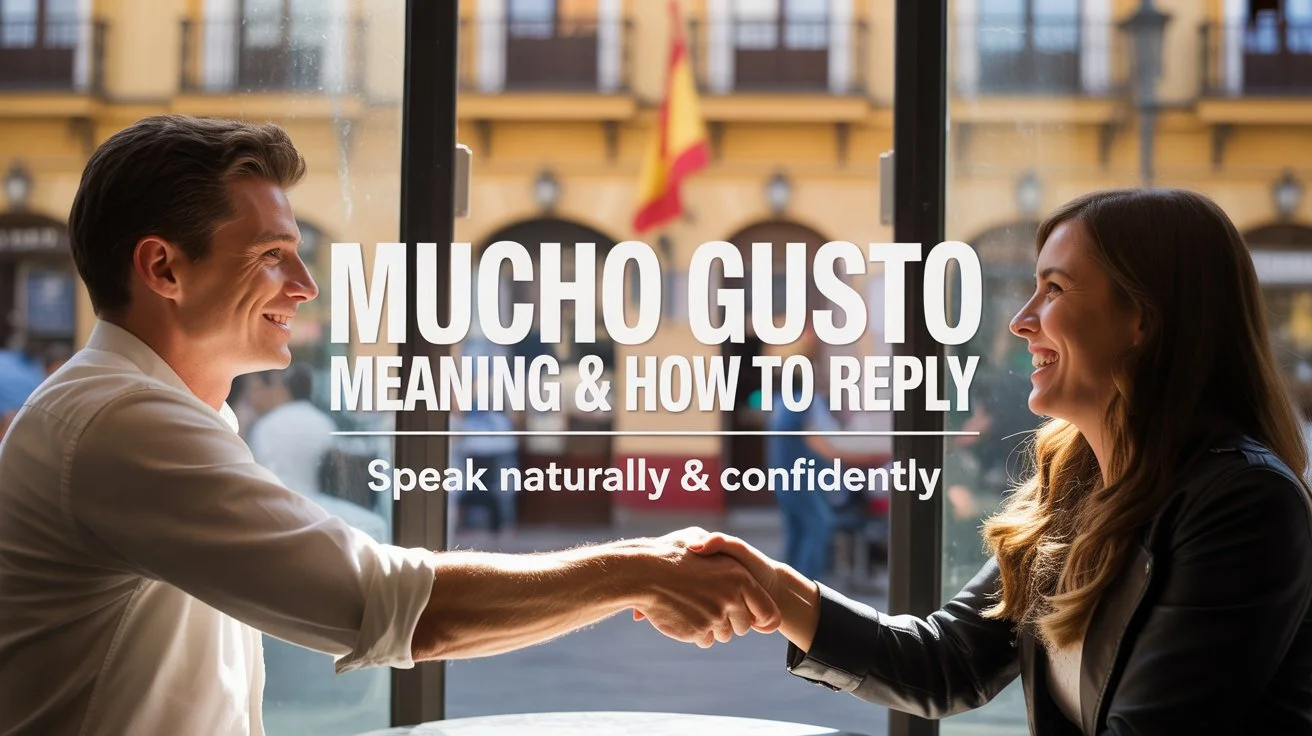
Mucho gusto means “Nice to meet you” in English.
That’s the short answer. But the full story is more interesting.
The phrase is built from two Spanish words:
- Mucho = Much / A lot
- Gusto = Pleasure / Liking / Taste
Put them together and you get the literal translation — “much pleasure.”
Nobody says “much pleasure” in English when meeting someone. It sounds strange. But in Spanish, it works beautifully. The phrase expresses genuine warmth toward the person you’re meeting for the first time.
What does mucho gusto mean in natural English? It depends on the setting:
| Context | Best English Equivalent |
|---|---|
| Everyday / Casual | “Nice to meet you” |
| Formal / Professional | “It’s a pleasure to meet you” |
| High-level / Business | “An honor to meet you” |
| Costa Rica (special case) | “You’re welcome” |
One Important Grammar Note Most Blogs Skip
Mucho gusto is gender-neutral. It never changes based on who is speaking.
You don’t say mucha gusto for a woman or mucho gusto for a man. It stays the same — always. This makes it one of the easiest Spanish phrases for English speakers to learn and use correctly.
This is different from phrases like encantado (male) and encantada (female), which do change based on the speaker’s gender.
Is Mucho Gusto “My Pleasure”?
Not exactly. Mucho gusto means “nice to meet you” — used during introductions.
“My pleasure” in Spanish is better expressed as “El gusto es mío” or “Con mucho gusto.”
They share the same root word — gusto — but they serve different moments in a conversation.
Why Do They Say Mucho Gusto?
Spanish-speaking cultures place deep value on courteous, warm first impressions. Saying mucho gusto when meeting someone signals that you’re respectful, approachable, and culturally aware.
It’s not just a phrase. It’s a social ritual — the verbal handshake of the Spanish-speaking world.
Must Visit: WYF Meaning: Understanding the Slang, Its Contexts, and How to Use It in 2026
The Cultural Weight Behind Mucho Gusto — More Than Just Words
Mucho gusto carries cultural meaning that goes far beyond its dictionary definition.
According to linguists and cultural researchers, greetings in Hispanic culture are deeply tied to respect, community, and human connection. A proper introduction isn’t just polite — it sets the entire tone of a relationship.
A Phrase With Deep Historical Roots
Here’s something almost no other guide covers: mucho gusto dates back to 16th-century Spain, where formal introductions were considered a mark of education and social standing. The phrase was used in aristocratic and courtly settings long before it became the everyday greeting it is today.
That history still lives in the phrase. Even now, saying mucho gusto signals that you were raised with good manners.
How It Varies by Region
Spanish is spoken in over 20 countries. The way mucho gusto is used — and received — shifts depending on where you are.
- Spain — People often prefer encantado or encantada in daily life. Mucho gusto is understood but used less frequently.
- Mexico & Colombia — Mucho gusto is the standard, everyday introduction phrase. It’s the first thing you’ll hear in a business meeting or at a social gathering.
- Costa Rica — The phrase con mucho gusto also means “you’re welcome.” If a Costa Rican says it after you thank them, they’re not re-introducing themselves — they’re expressing warmth in response to your gratitude.
- Argentina — Greetings are warmer and more physical. Mucho gusto is often paired with a hug or a kiss on the cheek, even in semi-formal settings.
Body Language That Goes With It
Words alone don’t carry full meaning in Spanish-speaking cultures. How you deliver mucho gusto matters just as much as the phrase itself.
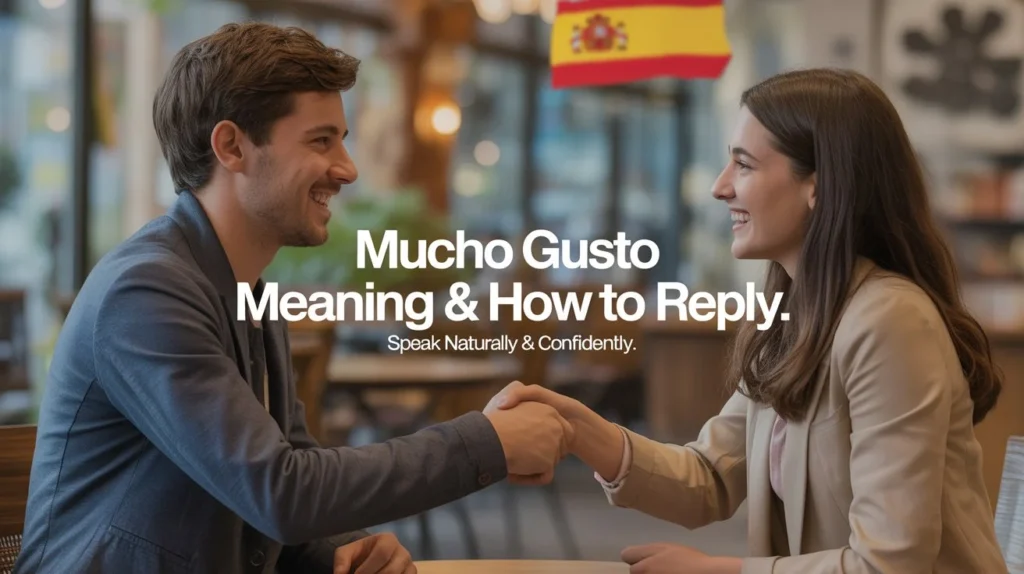
- Firm handshake — standard in professional, formal settings
- Cheek kiss — common in social, informal contexts (varies by country)
- Eye contact — essential everywhere; it signals sincerity and respect
- Genuine smile — transforms the phrase from mechanical to meaningful
As language expert María López puts it: “In Spanish culture, a greeting isn’t just words; it’s a gesture of respect and connection.”
Is “Me Gustas Mucho” Flirty?
Yes — and this is one of the most common points of confusion for English speakers.
Mucho gusto and me gustas mucho sound similar but mean completely different things.
- Mucho gusto = “Nice to meet you” — polite, neutral, appropriate for everyone
- Me gustas mucho = “I like you a lot” — this IS flirty and romantic in tone
Saying me gustas mucho to someone you just met in a professional setting would be deeply awkward. Know the difference before you speak.
How to Respond to Mucho Gusto — The Right Reply for Every Situation
How do you respond to mucho gusto? This is the question most learners freeze on.
Here’s the truth — there are several good responses. The right one depends on your setting and the tone of the conversation.
Full Response Guide
| Response | Meaning | Best Used When |
|---|---|---|
| Igualmente | Likewise / Same here | Any situation — the safest, most universal reply |
| El gusto es mío | The pleasure is mine | Formal meetings, professional settings |
| Encantado / Encantada | Delighted to meet you | Casual and formal — gender-specific |
| Un placer / Es un placer | A pleasure | Formal, common across Latin America |
| Con mucho gusto | With much pleasure | Warm, service or hospitality contexts |
| Mucho gusto también | Nice to meet you too | Simple, low-pressure, casual |
| Es un gusto conocerte | It’s a pleasure to meet you | Friendly and informal |
The Encantado / Encantada Rule
Unlike mucho gusto, encantado changes based on your gender.
- If you’re male → say encantado
- If you’re female → say encantada
You can also add de conocerlo/la for a more complete, formal version: “Encantado de conocerlo” — “Delighted to meet you.”
What No Other Blog Tells You
If you completely blank on the response — just say mucho gusto back.
It works. Native speakers use it this way too:
A: “Hola, soy Carlos. Mucho gusto.” B: “Mucho gusto, Carlos.”
Simple. Natural. Perfectly acceptable.
What NOT to Say
- ❌ Don’t say “Igual” alone — it sounds incomplete and unnatural
- ❌ Don’t say “Nice to meet you too” in English in a Spanish conversation mid-flow — it breaks the rhythm
- ❌ Don’t respond with silence — in Hispanic culture, a non-response to a greeting can feel rude
- ❌ Don’t say “mucho gusto” repeatedly in the same conversation — it’s for first introductions only
Real Dialogue Examples
Business setting:
A: “Señor García, le presento a John.” B: “Mucho gusto, señor García.” C: “El gusto es mío, John.”
Social gathering:
A: “Ana, esta es mi amiga Sofia.” B: “Mucho gusto, Sofia.” C: “Igualmente, Ana.”
Travel scenario:
Tourist: “Mucho gusto, doctora Ramírez.” Doctor: “Encantada. ¿En qué le puedo ayudar?”
How and When to Use Mucho Gusto — Real Contexts and Pronunciation
Knowing the phrase is one thing. Using it at the right moment — and saying it correctly — is everything.
When Mucho Gusto Fits Perfectly
- Meeting a new business contact or client
- Being introduced at a party or social event
- Checking into a hotel and meeting the staff
- Virtual introductions on video calls
- Formal ceremonies or academic events
- Greeting someone you met online for the first time in person
When NOT to Use It
- ❌ With friends or family you already know — it sounds stiff and robotic
- ❌ When leaving — use hasta luego (“see you later”) or nos vemos (“see you”)
- ❌ In very casual, quick interactions where hola is plenty
Pronunciation Guide for American Speakers
This is where many English speakers go wrong. Spanish vowels are pure and consistent — unlike English vowels, which shift depending on the word.
- Mucho → Say “MOO-choh” — the U sounds like “oo” in “moon,” not the U in “much”
- Gusto → Say “GOO-stoh” — not “GUS-toe”
Common American mispronunciation: saying mucho like macho. The vowel sounds are different — keep your lips rounded when you say the U.
Most Common Mistakes English Speakers Make
Mistake 1: Translating it literally and saying “much pleasure” in English — it sounds awkward. Stick to “nice to meet you.”
Mistake 2: Using mucho gusto when saying goodbye — it’s an introduction phrase, not a farewell.
Mistake 3: Overusing it — saying it every time you see the same person sounds robotic and rehearsed.
Correction practice:
❌ “Much pleasure to meet you.” ✅ “Mucho gusto, señora López.”
What Is “Sí Puedo”?
“Sí puedo” means “Yes, I can” in Spanish. It expresses willingness or ability to do something.
In the context of a conversation, you might hear: “¿Puede ayudarme?” (“Can you help me?”) — and the response would be “Sí, con mucho gusto” (“Yes, with much pleasure”).
This is where mucho gusto and sí puedo connect — both are used to express willingness and politeness in Spanish interaction.
How Do I Reply “I’m Fine” in Spanish?
When someone asks “¿Cómo estás?” (“How are you?”), here are your natural, confident replies:
- “Estoy bien, gracias.” — “I’m fine, thank you.” (most common)
- “Muy bien, gracias.” — “Very well, thank you.” (slightly more upbeat)
- “Bien, ¿y tú?” — “Fine, and you?” (casual, keeps the conversation flowing)
Pairing these responses with mucho gusto in the same conversation makes you sound fluent and naturally engaged.
Mucho Gusto Alternatives — Similar Spanish Greetings Worth Knowing
Mucho gusto isn’t the only way to greet someone in Spanish. Knowing the alternatives makes your Spanish sound richer and more natural.
Full Alternatives Comparison Table
| Phrase | Meaning | Tone | Gender Specific? |
|---|---|---|---|
| Encantado / Encantada | Pleased / Delighted to meet you | Formal & Casual | ✅ Yes |
| Un placer | A pleasure | Formal | ❌ No |
| Es un placer conocerte | It’s a pleasure to meet you | Warm, Informal | ❌ No |
| Qué gusto verte | What a pleasure to see you | Casual, Familiar | ❌ No |
| Me da gusto verte | I’m glad to see you | Friendly | ❌ No |
| Tanto gusto | So much pleasure | Enthusiastic | ❌ No |
| Con mucho gusto | With much pleasure / You’re welcome | Formal-Service | ❌ No |
| Gusto en conocerte | Pleasure in meeting you | Informal | ❌ No |
Mucho Gusto vs. Encantado — The Real Difference
Both phrases mean “nice to meet you.” But there are two key differences most blogs miss:
1. Gender: Mucho gusto never changes. Encantado does — encantado (male), encantada (female).
2. Emotional intensity: Encantado carries slightly more warmth and enthusiasm. It’s closer to “I’m delighted to meet you.” Mucho gusto is more neutral and universal.
In Spain, encantado/encantada is the go-to. In Mexico and Latin America, mucho gusto leads.
Con Mucho Gusto — The Phrase That Does Double Duty
“Con mucho gusto” literally means “with much pleasure.”
In most Spanish-speaking countries it’s used as a warm, emphatic version of mucho gusto.
But in Costa Rica specifically, it’s the standard way to say “you’re welcome” after someone thanks you. If you travel there and say gracias to a local, don’t be surprised when they smile and say con mucho gusto — they’re not starting an introduction.
Useful Phrases to Pair With Mucho Gusto
When you say mucho gusto, the conversation doesn’t stop there. Here’s what comes next:
- “¿Cómo estás?” — “How are you?”
- “¿Y tú?” — “And you?”
- “Hola, me llamo…” — “Hi, my name is…”
- “Soy de…” — “I’m from…”
- “Es un placer finalmente conocerle.” — “It’s a pleasure to finally meet you.” (great for professional settings)
These phrases flow naturally after mucho gusto and keep the conversation warm and engaging.
FAQs
Why do they say “mucho gusto”?
Mucho gusto is used because Spanish-speaking cultures deeply value warm, respectful first impressions. The phrase expresses genuine pleasure in meeting someone — it’s not just a formality. It signals that you consider the encounter meaningful. Historically rooted in 16th-century Spanish courtly etiquette, it became the everyday standard for introductions across the Spanish-speaking world.
Is mucho gusto “my pleasure”?
Not exactly. Mucho gusto primarily means “nice to meet you” and is used in introductions. “My pleasure” as a response to gratitude is better expressed as “el gusto es mío” or “con mucho gusto.” They share the word gusto but serve different conversational purposes.
Is “me gustas mucho” flirty?
Yes — absolutely. This is one of the most important distinctions for Spanish learners. “Me gustas mucho” means “I like you a lot” and carries clear romantic or flirtatious intent. “Mucho gusto” means “nice to meet you” and is completely neutral and polite. Using me gustas mucho in a professional or formal setting would be very inappropriate — always know which phrase you’re saying.
How do you respond to mucho gusto?
The safest, most universal response is “igualmente” — meaning “likewise.” Other great options include “el gusto es mío” (the pleasure is mine — formal), “encantado/encantada” (delighted — gender-specific), or simply “mucho gusto” back. Match the formality level of the person you’re speaking with.
What is “sí puedo”?
“Sí puedo” means “Yes, I can” in Spanish — expressing willingness or ability. It’s commonly used with con mucho gusto in service contexts: “¿Puede ayudarme?” → “Sí, con mucho gusto” (“Can you help me?” → “Yes, with much pleasure”). It reflects the same spirit of courtesy and helpfulness that mucho gusto embodies.
How do I reply “I’m fine” in Spanish?
The most natural responses are “Estoy bien, gracias” (I’m fine, thank you) or “Muy bien, gracias” (Very well, thank you). For a more conversational flow, add “¿Y tú?” (And you?) to keep the exchange going. These are the phrases you’ll use right after a mucho gusto exchange when someone follows up with “¿Cómo estás?”
Final Word
Mucho gusto is three syllables with centuries of cultural meaning behind them.
It’s how Spanish speakers open relationships — with warmth, respect, and genuine acknowledgment of the person in front of them.
Now you know exactly what it means, when to say it, how to respond, and what to avoid. You’re not just learning a phrase — you’re learning how to connect.
Next time someone says mucho gusto — smile, make eye contact, and say igualmente or el gusto es mío with confidence.
That’s all it takes.