Molto Meaning and Hiatus Meaning: A Comprehensive Guide
Molto is one of the most versatile words in the Italian language. It means very, much, many, and a lot — all depending on how you use it.
And if you have ever seen the word hiatus in a grammar book or music sheet — and wondered what it has to do with Italian — you are about to find out.
What Does Molto Mean? The Complete Definition
Molto Meaning in Italian: Much, Many, Very, and More
The short answer: molto means very, much, many, or a lot. It is one of the first words you will use in real conversations in Italy.
Its IPA pronunciation is /ˈmoʊltoʊ/. You stress the first syllable: MOL-to.
Here is the most important thing to know about molto meaning: its definition changes depending on what job it is doing in the sentence.
| Quick Definition: Molto = very (adverb) / much or many (adjective). The form changes only when it acts as an adjective. |
As an adverb, molto means very or a lot. It does not change. It stays as molto every single time:
- — È molto bella. (She is very beautiful.)
- — Studio molto. (I study a lot.)
- — Mi piace molto. (I like it a lot.)
As an adjective, molto means a lot of or many. It must match the gender and number of the noun it describes. This is called gender and number agreement — a core rule in Italian grammar:
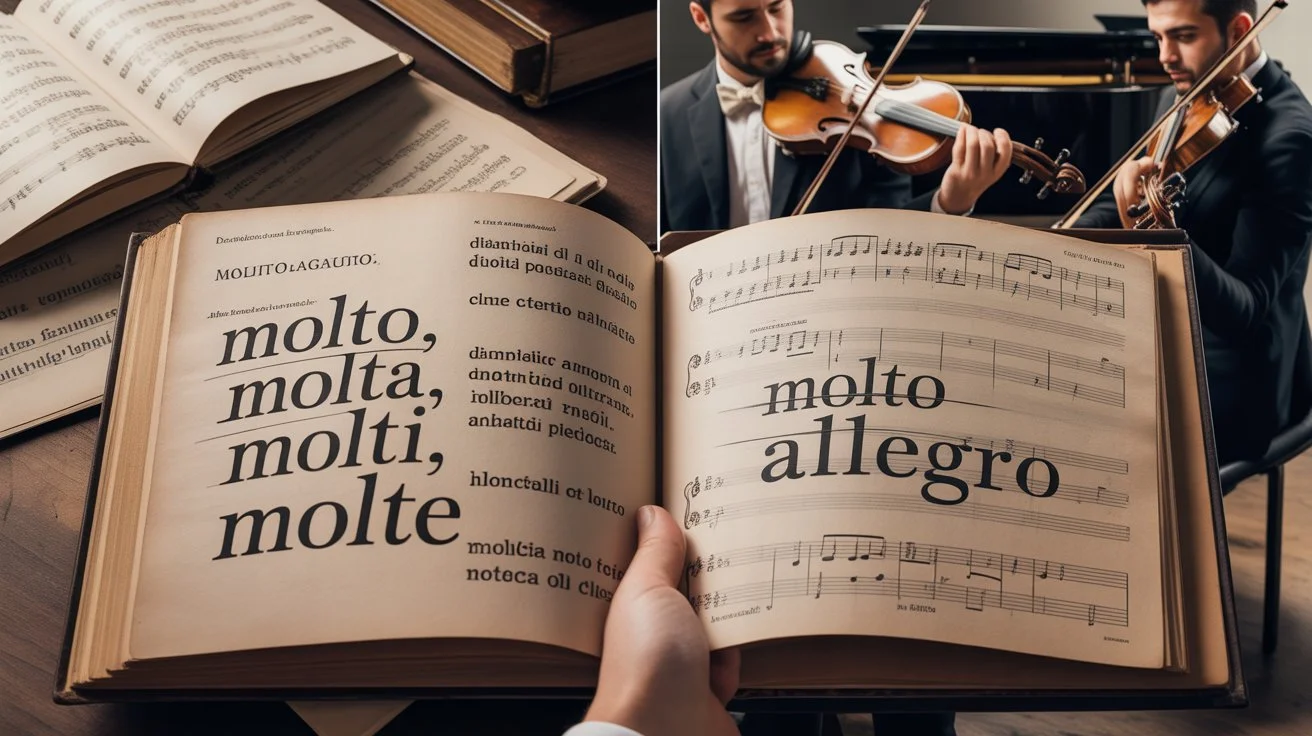
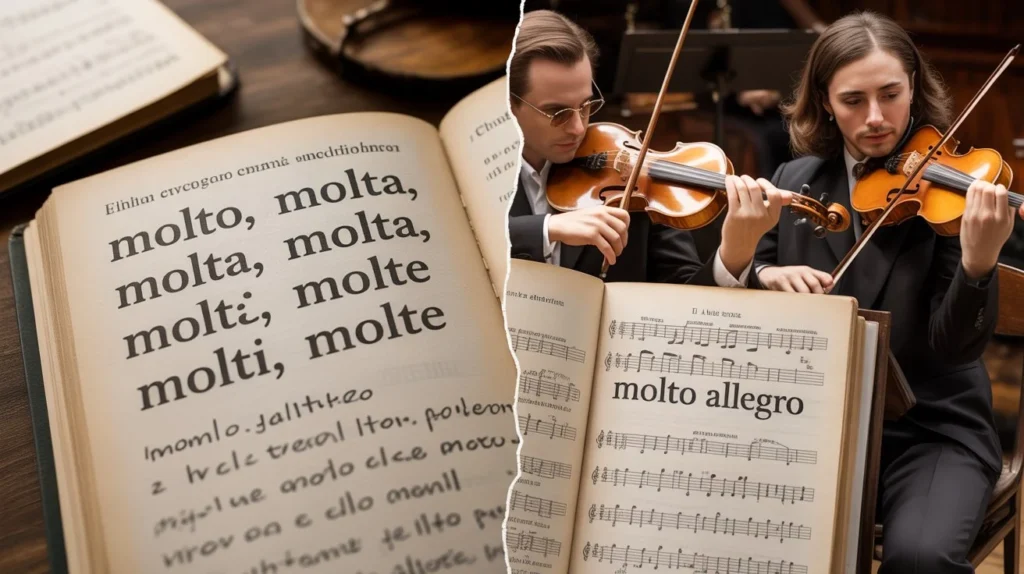
- Molto tempo — A lot of time (masculine singular)
- Molta pazienza — A lot of patience (feminine singular)
- Molti studenti — Many students (masculine plural)
- Molte persone — Many people (feminine plural)
Molto can also function as a pronoun, replacing the noun entirely when the context is clear:
- Non ho molto da dire. (I don’t have a lot to say.)
- Molti hanno cercato il tesoro. (Many have looked for the treasure.)
- In molti usano quel libro. (Many use that book.)
Molto Meaning in Music: How This Italian Word Directs Tempo and Expression
Beyond everyday conversation, molto in music is a widely used direction. Musicians across the world encounter it on sheet music almost every day.
In musical terminology, molto meaning in music is simple: it acts as an intensifier. It makes a tempo or expression marking stronger. Think of it as turning up the volume on an instruction.
Must Visit: Poison Tree Tattoo Meaning: Symbolism, Hidden Messages & Powerful Interpretations
| Music Definition: Molto = much / very — used to intensify a tempo or expression marking (e.g., molto adagio = very slowly). |
Here are the most common uses of molto in musical directions:
- Molto adagio — Very slowly (deeply expressive, slow pace)
- Molto allegro — Very fast (rapid and energetic)
- Molto vivace — Very lively (bright and spirited)
- Molto espressivo — Very expressively (with deep feeling)
- Molto tranquillo — Very quietly (hushed, still)
- Molto più animato — Much more lively
According to the Grove Music Online encyclopedia, Italian became the dominant language of music notation in the 17th century, largely because of Italy’s central role in operatic and classical composition. Terms like molto, allegro, piano, and forte became the universal vocabulary of written music.
This is why when you see molto adagio on a score, an orchestra in New York, London, or Tokyo all interpret it the same way.
The Latin Root Behind Molto — From Multum to Modern Italian
The word molto comes from the Latin word multum, which is the accusative singular neuter form of multus, meaning much or many. Its first recorded use in English (in the musical sense) dates to around 1795–1805.
You already use words built from this exact same Latin root every day in English:
- Multi- (prefix) — multicultural, multimedia, multilingual
- Multiple — more than one
- Multiply — to increase in number
This shared root makes molto linguistically close to familiar English words. That is one reason Italian language learners often pick it up quickly.
How Is Molto Used in Italian? Adverb vs. Adjective Explained
Molto as an Adverb: When the Form Never Changes
When molto is used as an Italian adverb, it is completely invariable. That means it never changes its ending — no matter what gender or number the rest of the sentence uses.
Use molto as an adverb when it comes after a verb or before an adjective:
- Lui mangia molto. (He eats a lot.) — after a verb
- Lei è molto stanca. (She is very tired.) — before a feminine adjective
- Questi ragazzi sono molto bravi. (These boys are very good.) — before a masculine plural adjective
- Suoni la chitarra molto bene. (You play guitar very well.) — before an adverb
Notice that even though stanca is feminine and bravi is masculine plural, molto stays the same. That is the adverb rule: invariable — it never changes.
Molto as an Adjective: Molto, Molta, Molti, Molte — Gender and Number Agreement
When molto acts as an Italian adjective — meaning it comes directly before a noun — it must match the noun in gender (masculine or feminine) and number (singular or plural).
Think of it like a chameleon. It changes its ending to fit the word next to it.
- Molto tempo (m. sing.) — A lot of time
- Molta neve (f. sing.) — A lot of snow
- Molti libri (m. pl.) — Many books
- Molte mele (f. pl.) — Many apples
A quick memory trick: if the noun ends in -o (masculine), use molto or molti. If it ends in -a (feminine), use molta or molte.
Moltissimo: The Absolute Superlative Form of Molto
Italian has a powerful grammar tool called the absolute superlative. You build it by dropping the final vowel of an adjective and adding -issimo (or -issima, -issimi, -issime depending on gender and number).
For molto, the absolute superlative becomes moltissimo. It means an enormous amount, a very great deal, or extremely much. English has no exact equivalent — we rely on words like very, extremely, or placing strong stress on the word a lot.
- Mi piace moltissimo il gelato. — I really, really like ice cream a lot.
- Alfredo studia moltissimo. — Alfredo studies an enormous amount.
- Abbiamo avuto moltissima pazienza. — We’ve been extremely patient.
- Lui ha moltissimi amici. — He has a very large number of friends.
Important spelling note: When the base adjective ends in -co or -go, an ‘h’ is inserted to preserve the hard sound before -issimo:
- Molto stanco → stanchissimo (very tired)
- Molto largo → larghissimo (very wide)
This is a detail most competitor blogs skip entirely — but it matters for correct Italian spelling.
You can also apply the -issimo pattern to the related words: tantissimo, pochissimo, giving you a full set of superlative intensifiers.
Molto vs. Tanto vs. Poco vs. Troppo — What Is the Real Difference?
Molto vs. Tanto: Neutral Fact vs. Emotional Emphasis
Both molto and tanto can mean very or a lot. Both follow the same grammar rules — invariable as adverbs, variable as adjectives.
So what is the difference? It comes down to emotional weight.
- Molto is neutral and factual. It describes quantity or degree without added feeling.
- Tanto adds emotional color — surprise, warmth, or emphasis on how large the amount feels.
Compare these two sentences:
- Mi piace molto. (I like it a lot.) — neutral statement
- Mi piace tanto! (I really like it — so much!) — warm, emotional, emphatic
Native Italian speakers tend to use tanto in personal, heartfelt conversations and molto in more formal or descriptive contexts. This nuance is rarely explained in beginner resources.
Molto vs. Poco: Opposite Ends of the Italian Quantity Spectrum
Poco is the direct opposite of molto. Where molto means much or many, poco means little, few, or not much. It follows the exact same grammar rules:
- Poco tempo — little time (m. sing.)
- Poca acqua — little water (f. sing.)
- Pochi libri — few books (m. pl.)
- Poche persone — few people (f. pl.)
As an adverb: Marco legge poco (Marco reads a little). As a superlative: pochissimo — extremely little.
Molto vs. Troppo and Parecchio: Knowing When Too Much Is Too Much
Troppo means too much or too many. It carries a sense of excess — going beyond what is comfortable or acceptable.
- Alessio mangia troppa carne. (Alessio eats too much meat.)
- Oggi è troppo caldo. (Today it is too/so hot.)
- Gianna lavora troppo. (Gianna works too much.)
Parecchio is an often-overlooked word that means quite a lot or several. It sits between molto and troppo on the quantity scale — more than a little, but not excessive.
- Ho parecchio lavoro da fare. (I have quite a lot of work to do.)
- Ci sono parecchi studenti. (There are several students.)
Full Declension Comparison Table — all five words side by side:
| Word | M. Sing. | F. Sing. | M. Plural | F. Plural |
| Molto | molto | molta | molti | molte |
| Tanto | tanto | tanta | tanti | tante |
| Poco | poco | poca | pochi | poche |
| Troppo | troppo | troppa | troppi | troppe |
| Parecchio | parecchio | parecchia | parecchi | parecchie |
Also worth knowing: Italian has vivid informal synonyms for molto that you will hear in everyday speech:
- Un sacco — literally ‘a sack’; means loads of
- Un mucchio — literally ‘a pile’; means a heap of
- Una marea — literally ‘a tide’; means a flood of
- Un casino — literally ‘a chaos’; very informal, means a ton of
- Una barca — literally ‘a boat’; means boatloads of
What Is Hiatus Meaning — And What Does It Have to Do With Molto?
Hiatus Meaning: Definition, Origin, and Everyday Usage in English
The word hiatus comes from the Latin verb hiare, meaning to gape or to yawn. In everyday English, hiatus means a pause, break, or gap — an interruption between two events or periods of activity.
You hear it most often in phrases like:
- ‘The band is on hiatus.’ (They have paused their activity.)
- ‘After a two-year hiatus, the show returned.’ (A gap in broadcasting.)
- ‘She took a hiatus from work to travel.’ (A deliberate break.)
The word implies the interruption is temporary — there is an expectation of return or continuation. That is what separates a hiatus from a permanent end.
Hiatus in Linguistics: Vowel Sounds, Syllable Breaks, and Italian Pronunciation
In linguistics and phonetics, hiatus has a very specific meaning. It refers to a situation where two vowel sounds appear next to each other — in adjacent syllables — without any consonant sound between them.
Each vowel forms its own separate syllable. The result is a slight break or gap between the two sounds as the speaker transitions from one vowel to the next.
| Linguistic Definition: Hiatus = two adjacent vowel sounds in separate syllables, with no consonant between them. Each vowel is pronounced distinctly. |
Examples in English:
- co-op — two vowel sounds ‘o’ and ‘o’ in separate syllables
- re-enter — ‘e’ and ‘e’ across a syllable boundary
- naïve — the two dots (diaeresis) signal a hiatus between ‘a’ and ‘i’
Examples in Italian:
- paese (pa-e-se) — country — the ‘a’ and ‘e’ are in hiatus
- io (i-o) — I — two vowels, each its own syllable
- aorta (a-or-ta) — medical term used in Italian too
The Connection Between Hiatus and Learning Italian Words Like Molto
Understanding hiatus in linguistics is directly useful when learning Italian pronunciation.
Italian is a phonetically regular language — meaning almost every letter is pronounced. But when two vowels meet at a syllable boundary, knowing whether you face a hiatus, a diphthong, or a triphthong determines how you pronounce the word correctly.
Hiatus vs. Diphthong — this is the key distinction most learners miss:
- Hiatus: Two vowels, two separate syllables, each vowel fully pronounced (pa-e-se).
- Diphthong: Two vowels that glide into each other within a single syllable (like ‘ua’ in guanto — glove).
In the word molto itself — mol-to — there is no hiatus because both syllables contain consonants. But knowing hiatus rules helps you correctly syllabify other Italian words like poi, mai, vuoi, and buono.
For learners working toward certifications like CEFR A1 through B2, understanding phonetic concepts like hiatus directly improves both pronunciation accuracy and listening comprehension.
The 4 Types of Tempo in Music — And Where Molto Fits
The Four Main Tempo Markings Every Music Student Should Know
Tempo is the speed at which a piece of music is performed. It is measured in BPM (beats per minute). Italian tempo markings have been the global standard since the 17th century, and they are still used on sheet music worldwide today.
The four primary tempo categories — each representing a broad speed range — are:
| Tempo Type | BPM Range | Feeling | Molto Example |
| Grave / Largo | 40–60 BPM | Very slow, solemn | Molto adagio |
| Andante | 66–76 BPM | Walking pace | Molto andante |
| Allegro | 120–156 BPM | Fast, lively | Molto allegro |
| Presto | 168–200 BPM | Very fast | Molto vivace |
Where Molto Fits: Molto Adagio, Molto Allegro, Molto Vivace Explained
The word molto acts as an intensifier in musical directions. It pushes a tempo marking toward its extreme. It makes a slow tempo slower and a fast tempo faster.
- Molto adagio — Extremely slow and expressive. Found in deeply emotional movements of classical compositions.
- Molto allegro — Faster than standard allegro. Energetic and driven.
- Molto vivace — Very lively and bright. Often used in scherzo movements.
- Molto moderato — More restrained than a typical moderato. Measured and controlled.
Beethoven, Mozart, and Brahms all used molto extensively in their scores. Beethoven’s Symphony No. 9 contains several molto vivace passages in the scherzo movement — among the most recognized uses in Western classical music history.
How Italian Music Terms Like Molto Shape the Way We Hear Music
Italian became the universal language of musical notation for a reason. By the 17th and 18th centuries, Italian composers — particularly from Venice, Naples, and Rome — were the most influential in Europe. Their terminology traveled with their music.
Today, the Royal Conservatoire of Scotland and similar institutions teach Italian tempo terminology as a core part of music theory at every level. When a conductor says molto espressivo, every trained musician in the ensemble understands instantly — no translation needed.
Understanding molto meaning in music is therefore not just a language exercise. It is a fundamental part of musical literacy.
FAQs
| ❓ What does molto mean? Molto is an Italian word meaning very, much, many, or a lot. As an adverb, it stays unchanged (molto bello — very beautiful). As an adjective, it changes to match the noun: molto, molta, molti, or molte. |
| ❓ How is molto used in Italian? Molto is used two ways. As an adverb before an adjective or after a verb, it means very or a lot and never changes form. As an adjective before a noun, it must agree in gender and number with that noun — molto (m. sing.), molta (f. sing.), molti (m. pl.), molte (f. pl.). |
| ❓ What is molto Italian? Molto is an Italian adverb and adjective derived from the Latin word multum, meaning much or many. It is one of the most commonly used words in everyday Italian conversation and is also widely used in musical notation. |
| ❓ What does molto mean in music? In music, molto means very or much. It is placed before or after a tempo or expression marking to intensify it. For example, molto adagio means very slowly, and molto allegro means very fast. It has been a standard Italian music term since the 17th century. |
| ❓ Do molto meaning? Yes — molto carries multiple meanings depending on context. It means very when used as an adverb (molto bello), and it means much, many, or a lot of when used as an adjective before a noun (molti libri — many books). |
| ❓ What are the 4 types of tempo? The four main tempo types in music are: Grave/Largo (very slow, 40–60 BPM), Andante (moderate walking pace, 66–76 BPM), Allegro (fast and lively, 120–156 BPM), and Presto (very fast, 168–200 BPM). Adding molto before any of these intensifies the marking — molto allegro is faster than allegro alone. |
Conclusion
Both molto meaning and hiatus meaning are more layered than they first appear.
Molto is not just a word for very. It is a grammar-sensitive tool that changes form, intensifies music, and connects Italian to its Latin roots. Hiatus is not just a break — in linguistics, it describes how vowels interact across syllable boundaries, shaping the sound of every Italian word you pronounce.
Master these two concepts, and you gain a stronger grip on both Italian language learning and musical literacy — two deeply connected worlds built on the foundation of la dolce lingua.