
Kroner Meaning: History, Symbolism, and Modern Use
Most people hear Kroner and think: money. But this word carries something much older than a price tag.
It holds royal history, national identity, and cultural pride — all packed into one small word. Whether you’re a traveler heading to Scandinavia, a finance enthusiast tracking exchange rates, or simply curious about the word, this guide covers everything you need to know about Kroner meaning — from its Latin roots to its modern digital slang.
What Is Kroner? Definition and Meaning in English
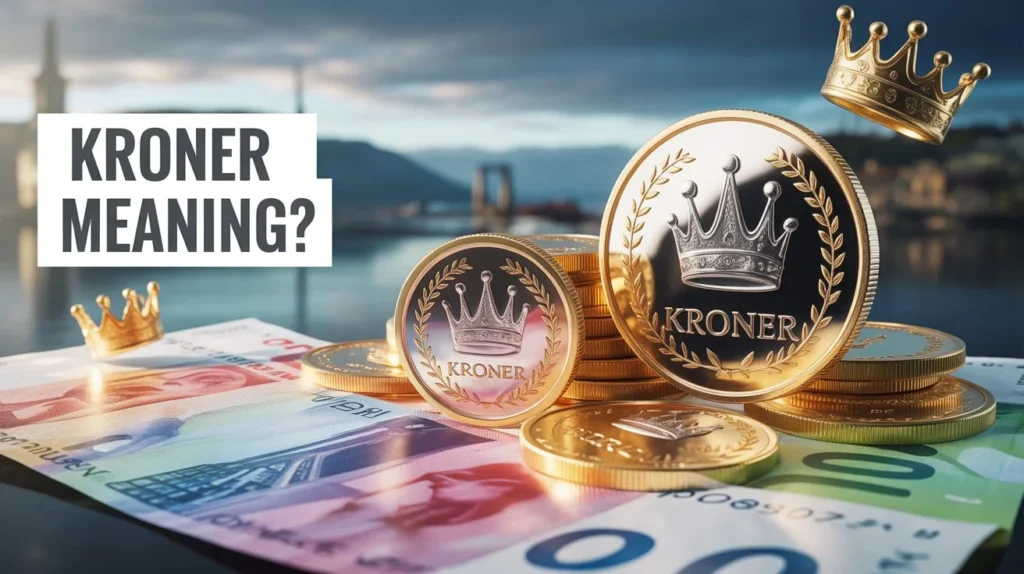
What is the meaning of Kroner? Simply put, Kroner is the plural form of Krone, which means “crowns” in English. One unit = Krone. Multiple units = Kroner.
The word traces back to the Latin corona, meaning crown. From Latin, it passed through Middle Low German (krūne) and eventually became the Danish and Norwegian Krone — the name both countries chose for their national currencies.
According to Collins English Dictionary, Kroner refers specifically to the monetary units of Denmark and Norway. Merriam-Webster defines Krone as “the basic monetary unit of Denmark and Norway.” Cambridge Dictionary describes it as “the standard unit of money used in Denmark and Norway.”
| 📌 Quick Definition Krone (singular) = 1 Crown | Kroner (plural) = multiple Crowns |
Krone vs Kroner — What’s the Difference?
This is one of the most searched questions online, and the answer is simple.
Krone is singular — you use it when talking about one unit. Kroner is plural — you use it for more than one unit. Think of it like “dollar” and “dollars.”
Example: “I paid 1 Krone for a candy bar” vs. “I paid 20 Kroner for lunch.”
Also note: Sweden uses a related but separate currency called Krona (SEK), and the plural is Kronor. These are not the same as Krone/Kroner.
Must Visit: Snowball Kiss Meaning: What It Is, Origin & Real Explanation
Kroner Meaning in English — More Than Just Money
When translated literally, Kroner means “crowns” — a direct reference to royal authority. This wasn’t a random choice.
Scandinavian monarchies intentionally named their currencies after the crown to signal sovereignty, national pride, and monetary strength. Every time someone used a Krone coin, they were, in a sense, holding a miniature crown.
This is a layer of meaning most financial guides completely ignore — but it’s essential to understanding why the word carries cultural weight beyond its face value.
The History of Kroner — From Latin Roots to Scandinavian Currency
The story of Kroner starts in ancient Rome, travels through medieval Europe, and lands firmly in modern Scandinavia.
The Latin word corona (crown) was widely used on early European coins as a symbol of royal authority. Over centuries, this imagery became so tied to money that “crown” became the name of the currency itself in multiple countries.
The Scandinavian Monetary Union — How Kroner Was Born
In 1873, Denmark and Sweden formed the Scandinavian Monetary Union. Norway joined in 1875. This agreement unified the three nations under a shared Krone system, replacing older currencies like the Speciedaler in Norway.
The union created a stable shared monetary zone — similar in concept to what the Euro does today — but it was built on gold-backed Krone coins instead of a centralized bank.
The union lasted until 1914, when World War I disrupted European financial systems and the gold standard began to collapse. Each country went its separate monetary way.
Why Norway and Denmark Kept the Kroner After the Union Collapsed
Even after the union ended, both Norway and Denmark kept the Krone as their national currency. This was a conscious decision rooted in national identity and financial independence.
Sweden kept a similar system as the Swedish Krona (SEK). But each country now manages its own monetary policy independently.
Today, the Norwegian Krone (NOK) is managed by Norges Bank, while the Danish Krone (DKK) is overseen by Danmarks Nationalbank. Both currencies have survived over 150 years since their introduction in the 1870s — a testament to their deep institutional and cultural roots.
Kroner Currency — Norwegian Krone vs Danish Krone Explained
What is the Kroner? There are two major Kroner in active use today: the Norwegian Krone (NOK) and the Danish Krone (DKK). They share a name and history, but they work very differently.
Norwegian Krone (NOK) — The Oil-Backed Currency
The Norwegian Krone is the official currency of Norway, introduced in 1875. Its ISO code is NOK, its symbol is kr, and it is subdivided into 100 Øre (though coins below 1 Krone are no longer in circulation).
Norway’s Krone is a floating currency — its value is determined by open market forces, not fixed to any other currency. This makes it sensitive to global oil prices, since Norway is one of the world’s leading energy exporters.
When oil prices rise, the NOK strengthens. When oil prices fall, it weakens. As of recent data, 1 USD ≈ 10.5 NOK, though this fluctuates significantly.
| 💡 Did You Know? Norway’s Government Pension Fund Global — funded by oil revenues — is the world’s largest sovereign wealth fund, valued at over $1.7 trillion. The NOK’s strength is directly tied to this fund’s performance. |
Danish Krone (DKK) — Europe’s Pegged Independent Currency
The Danish Krone is the official currency of Denmark, Greenland, and the Faroe Islands. Its ISO code is DKK, and its symbol is also kr.
Unlike Norway’s floating Krone, the DKK is pegged to the Euro through the ERM II (Exchange Rate Mechanism II). This keeps the DKK stable relative to the Euro, with only minor fluctuations allowed. Currently, 1 USD ≈ 7 DKK.
Denmark is an EU member but has not adopted the Euro. Danish voters rejected full Euro adoption in a 2000 referendum. Despite this, the DKK’s peg means it effectively moves in lockstep with the Euro — giving Denmark stability without surrendering its own currency.
| Feature | Norwegian Krone (NOK) | Danish Krone (DKK) |
| Introduced | 1875 | 1875 |
| Currency System | Floating | Pegged to Euro (ERM II) |
| Central Bank | Norges Bank | Danmarks Nationalbank |
| Subunit | Øre (discontinued) | Øre (below 50 phased out) |
| Main Influence | Oil & gas prices | EU trade & Euro stability |
| ISO Code | NOK | DKK |
| Used In | Norway | Denmark, Greenland, Faroe Islands |
| USD Rate (approx.) | ~10.5 NOK | ~7 DKK |
For US travelers visiting either country: you cannot use US dollars or Euros directly. You’ll need to exchange currency. In Denmark, however, ATMs and most merchants quote prices that closely mirror the Euro thanks to the peg.
Kroner Symbolism — The Crown Behind the Currency
This is the part most financial articles skip entirely. But understanding Kroner symbolism gives you a far richer picture of what this word means.
Why Kroner Means More Than Money — The Crown Symbolism
The crown has been a symbol of power, authority, and divine right in European culture for over a thousand years. When Scandinavian nations named their currency the Krone, they were making a deliberate statement: this money represents the strength and sovereignty of our kingdom.
This symbolism is still visible on Krone coins today. Danish Krone coins feature the likeness of the reigning monarch — currently King Frederik X. Norwegian Krone coins have featured the Royal Monogram and national symbols like the lion crest.
Every time a coin changes hands in Copenhagen or Oslo, it carries with it this centuries-old link to crown, country, and identity.
Kroner in Pop Culture, Slang, and Modern Online Language
Because Kroner sounds exotic and European to American ears, it has slipped into digital culture in interesting ways.
Urban Dictionary lists informal uses like “Stacking Kroner” — slang for accumulating wealth with a high-class, European flair. In gaming communities, Kroner is sometimes used humorously as a stand-in for in-game currency or loot.
On TikTok and Instagram, creators use it in captions tied to luxury travel, Nordic aesthetics, or ironic wealth humor. It’s not mainstream slang, but its usage in memes and online content has grown as Scandinavian culture (think hygge, Norse mythology, Viking aesthetics) has surged in global popularity.
In Scandinavian cinema and television — particularly in popular Danish series — Kroner appears naturally in dialogue as an authentic marker of setting and culture.
The surname Kroner also exists across Germany, Austria, and Scandinavia, historically linked to families involved in royal courts or money-handling professions. Notable namesakes include Austrian painter Ferdinand Kroener and German actress Hannelore Krone.
How to Use Kroner in a Sentence — Real Examples for English Speakers
How do you use Kroner in a sentence? This is one of the top searched questions about this word — and the answer depends on context.
Kroner in Formal Writing vs Everyday Conversation
In formal or journalistic writing, you’ll see Kroner capitalized and paired with the country name for clarity:
✔ “DAB sets for the home cost around 1,000 kroner.” — The Guardian
✔ “Revenue was up by 1 per cent to 39.1 billion kroner.” — The Sunday Times
✔ “He raised a figure of 200,000 kroner ($23,000).” — The Sunday Times
✔ “The offer values the company at 10.5 billion kroner.” — Globe and Mail
✔ “I handed over a 200 kroner note.” — The Guardian
In everyday conversation, especially for American English speakers:
✔ “He exchanged his dollars for Norwegian Kroner before flying to Oslo.”
✔ “The hotel room cost 800 Danish Kroner — about $115 at today’s rate.”
A key rule: use Krone when referring to a single unit and Kroner for any amount more than one. Both forms are acceptable in English without capitalization unless starting a sentence or used as a proper noun in a financial document.
Frequently Asked Questions About Kroner Meaning
What is the meaning of Kroner?
Kroner is the plural of Krone, which means “crowns” in English. It refers to the official currency used in Norway (NOK) and Denmark (DKK). The word originates from the Latin corona, meaning crown, and was adopted across Scandinavia in the 1870s.
Why is it called Kroner?
It is called Kroner because Scandinavian monarchies named their currency after the royal crown — a symbol of national sovereignty and authority. The Latin corona evolved into Krone across Danish and Norwegian, and the plural naturally became Kroner. The name was a deliberate choice to tie monetary value to royal legitimacy.
What is the Kroner?
The Kroner is the monetary system used in Norway and Denmark. Norway’s NOK is a floating currency heavily influenced by oil and gas markets. Denmark’s DKK is pegged to the Euro through ERM II, giving it greater stability. Both were introduced in 1875 as part of the Scandinavian Monetary Union.
How do you use Kroner in a sentence?
Simply use it as you would any currency name: “She paid 500 Norwegian Kroner for the guided tour.” or “The budget was set at 2 million Danish Kroner.” Use Krone for singular amounts and Kroner for plural.
Where do people use Kroner?
Kroner is actively used in Norway, Denmark, Greenland, and the Faroe Islands. The related but distinct Swedish Krona (SEK) is used in Sweden. Iceland uses the Króna (ISK). All trace back to the same Latin corona root but are separate, independent currencies.
What are 5 examples of sentences using Kroner?
1. “He exchanged his dollars for Norwegian Kroner at Oslo Airport.”
2. “The apartment rental costs 12,000 Danish Kroner per month.”
3. “Revenue rose to 39 billion Kroner in the third quarter.”
4. “I handed the cashier a 200 Kroner note and waited for change.”
5. “DAB sets for the home cost around 1,000 Kroner at most electronics stores.”
Final Thoughts
Kroner is more than a currency. It is a living word — one that connects ancient Latin roots to modern Scandinavian economies, and royal symbolism to everyday transactions.
Whether you’re tracking the NOK exchange rate, planning a trip to Copenhagen or Oslo, or just curious about where the word comes from, now you have the full picture. The next time you hear Kroner, you’re not just hearing money — you’re hearing centuries of history in two syllables.